
Bathroom Accessories Manufacturer: A Complete Guide to Choosing the Right Factory for Your Brand
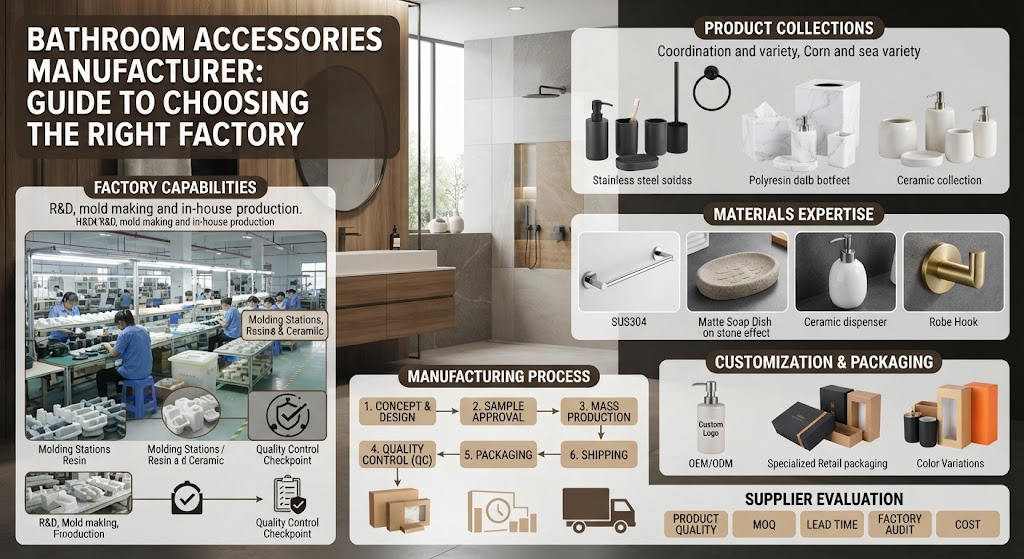
When developing a new bathroom collection, choosing the right bathroom accessories manufacturer is one of the most important decisions for a retailer, importer, wholesaler, hotel supplier, or private-label brand.
Bathroom accessories may look like relatively simple products, but successful manufacturing requires much more than simply producing a soap dispenser or toothbrush holder. Material selection, product design, mold development, surface finishing, color consistency, packaging, quality control, production capacity, MOQ, lead time, and shipping all directly affect the final cost and customer experience.
A professional bathroom accessories manufacturer should therefore be more than a supplier. The right factory should be able to help you develop commercially viable products, maintain consistent quality, control production costs, and scale your collection as your business grows.
This guide explains how to evaluate a bathroom accessories manufacturer, what products and materials are available, how OEM and ODM manufacturing works, what questions buyers should ask, and how to select the right factory for your market.
What Is a Bathroom Accessories Manufacturer?
A bathroom accessories manufacturer is a factory or manufacturing company that develops and produces bathroom-related accessories for retailers, wholesalers, importers, hospitality companies, distributors, and private-label brands.
Typical bathroom accessories include:
Soap dispensers
Toothbrush holders
Tumblers
Soap dishes
Tissue boxes
Toilet brush holders
Bathroom trash bins
Bathroom trays
Towel racks
Towel bars
Robe hooks
Toilet paper holders
Bathroom shelves
Cosmetic organizers
Bathroom accessory sets
Manufacturers may specialize in one material, such as resin or stainless steel, or offer multiple materials and production processes.
For example, some manufacturers specialize in brass and stainless steel bathroom hardware, while others manufacture resin, ceramic, stoneware, plastic, or mixed-material bathroom accessories. Current manufacturers appearing for this search term commonly position themselves around OEM/ODM, private label, material expertise, and complete production services.
For buyers, understanding the manufacturer’s actual production capabilities is more important than simply looking at the size of its product catalog.
What Products Can a Bathroom Accessories Manufacturer Produce?
A professional factory should be able to provide either individual products or coordinated collections.
1. Soap Dispensers
Soap dispensers are one of the most popular bathroom accessories for residential, hotel, and retail markets.
Common options include:
Resin soap dispensers
Ceramic soap dispensers
Glass soap dispensers
Stainless steel soap dispensers
Plastic soap dispensers
Lotion dispensers
Liquid soap bottles
For retail brands, the dispenser is often an important visual product because it can establish the overall design language of an entire bathroom collection.
2. Toothbrush Holders
Toothbrush holders can be manufactured in different shapes, sizes, and materials.
Popular designs include:
Round toothbrush holders
Square toothbrush holders
Ribbed toothbrush holders
Minimalist toothbrush holders
Multi-compartment toothbrush holders
Matching toothbrush holders for bathroom sets
The best manufacturers can develop the toothbrush holder together with other accessories so that colors, textures, dimensions, and finishes remain consistent.
3. Tumblers and Bathroom Cups
Bathroom tumblers are commonly used for:
Toothbrush storage
Rinsing
Cosmetic organization
Hotel guest bathrooms
Residential bathroom collections
For retail collections, matching the tumbler with the soap dispenser, toothbrush holder, and soap dish can create a stronger visual presentation.
4. Soap Dishes
Soap dishes remain a popular accessory for both traditional and modern bathroom designs.
Manufacturers can develop:
Flat soap dishes
Drainage soap dishes
Raised soap dishes
Ribbed soap dishes
Stone-effect soap dishes
Minimalist soap dishes
Decorative resin soap dishes
5. Tissue Boxes
Bathroom tissue boxes are particularly useful for creating a coordinated collection.
They can be designed with:
Matching colors
Matching textures
Logo customization
Custom dimensions
Retail packaging
Hotel packaging
6. Bathroom Trash Bins
Bathroom trash bins are another important category for complete bathroom collections.
Depending on the target market, manufacturers can develop different capacities, shapes, colors, and textures.
For example, a premium resin collection may include a matching trash bin, tissue box, soap dispenser, toothbrush holder, tumbler, and soap dish.
What Materials Are Used for Bathroom Accessories?
Material selection is one of the most important decisions when developing bathroom accessories.
Different materials provide different combinations of appearance, durability, weight, cost, and design flexibility.
Resin Bathroom Accessories
Resin, especially polyresin, has become an attractive material for decorative bathroom accessories because it provides considerable design flexibility.
Resin can be developed with:
Marble effects
Stone effects
Sandstone textures
Ribbed textures
Terrazzo effects
Matte finishes
Gloss finishes
Solid colors
Mixed-color effects
This makes resin particularly suitable for decorative bathroom collections where visual appearance is an important purchasing factor.
A resin bathroom accessories manufacturer can also develop coordinated products such as:
Soap Dispenser + Toothbrush Holder + Tumbler + Soap Dish
and expand the collection with:
Tissue Box + Trash Bin + Bathroom Tray + Toilet Brush Holder
This allows retailers to create a complete bathroom collection instead of purchasing unrelated individual products.
Stainless Steel Bathroom Accessories
Stainless steel is widely used for bathroom hardware because of its corrosion resistance and durability.
Typical products include:
Towel bars
Towel rings
Toilet paper holders
Shower shelves
Robe hooks
Bathroom racks
Manufacturers often use grades such as SUS304 for higher-performance applications.
Brass Bathroom Accessories
Brass is commonly used for premium bathroom hardware.
It can support finishes such as:
Chrome
Brushed brass
Polished brass
Matte black
Gold
PVD finishes
Brass is especially common in premium residential, hospitality, and architectural projects.
Ceramic Bathroom Accessories
Ceramic is frequently used for:
Soap dishes
Soap dispensers
Tumblers
Toothbrush holders
Bathroom sets
Ceramic can provide a premium appearance but may have different manufacturing, packaging, and transportation requirements compared with resin.
Why Choose a Bathroom Accessories Manufacturer Instead of a Trading Company?
One of the first questions B2B buyers should ask is whether they are dealing directly with a factory.
A direct manufacturer can potentially provide greater control over:
Product development
Quality control
Production scheduling
Customization
Packaging
Cost management
New product development
Communication with engineers
Some manufacturers specifically position themselves as manufacturing partners rather than trading companies, emphasizing in-house product development and production capabilities.
However, buyers should not assume that every company calling itself a “manufacturer” actually owns every production process.
Before placing an order, ask:
Do you own your factory?
What production processes are in-house?
Do you have your own mold or tooling department?
Do you have an R&D team?
Where is quality control performed?
Which processes are outsourced?
Can you provide factory photos or a factory video?
Can you provide product samples before bulk production?
These questions can help distinguish a genuine manufacturing partner from a trading intermediary.
OEM vs. ODM: What Is the Difference?
Many buyers search for a bathroom accessories OEM manufacturer or bathroom accessories ODM manufacturer.
Although the terms are often used together, they represent different development models.
What Is OEM Bathroom Accessories Manufacturing?
OEM means that the buyer provides the product concept, design, drawing, specifications, or brand requirements, and the manufacturer produces the item according to those requirements.
OEM can include:
Custom dimensions
Custom colors
Custom materials
Custom logos
Custom packaging
Custom finishes
Custom product structures
OEM is particularly suitable for brands that already have their own product designs.
What Is ODM Bathroom Accessories Manufacturing?
ODM means that the manufacturer contributes more to product development.
The factory may provide:
Existing designs
New product concepts
Trend-based collections
Product development
Material recommendations
Color recommendations
Prototype development
Mold development
ODM is useful for retailers and importers that want to launch a new bathroom collection but do not have a large internal product development team.
A strong ODM manufacturer can help transform a general idea such as “modern neutral bathroom collection” into a complete commercial product line.
What Should You Look for in a Bathroom Accessories Manufacturer?
Choosing a manufacturer based only on price can create problems later.
Instead, evaluate the factory across several important areas.
1. Product Development Capability
A good manufacturer should be able to help with product development rather than simply reproduce existing products.
Ask whether the factory has:
Product designers
Engineers
Mold development
3D modeling
Prototyping
Color development
Structural optimization
For competitive retail collections, product development capability can be just as important as production capacity.
2. Material Expertise
The manufacturer should understand how different materials affect:
Product cost
Weight
Durability
Appearance
Manufacturing difficulty
Packaging
Shipping
For example, resin may be a strong option for decorative bathroom accessories where unique shapes, textures, and colors are important.
3. Quality Control
Quality control should cover the entire manufacturing process.
A professional quality-control system may include:
Incoming Material Inspection
Raw materials should be inspected before entering production.
In-Process Inspection
Products should be checked during production rather than waiting until the end.
Appearance Inspection
Inspectors should check:
Scratches
Cracks
Surface defects
Color differences
Bubbles
Uneven finishing
Assembly problems
Final Inspection
Finished products should be inspected before packing and shipment.
Some established manufacturers describe systems involving IQC, IPQC and OQC, as well as additional tests for specific bathroom hardware applications.
How Important Is MOQ When Choosing a Bathroom Accessories Factory?
MOQ means Minimum Order Quantity.
Different manufacturers may have very different MOQ requirements.
For example, an established factory may offer:
Lower MOQ for existing products
Higher MOQ for customized products
Different MOQ for new molds
Different MOQ for custom packaging
Buyers should ask for separate MOQ information for:
Existing Products
Custom Colors
Custom Logo
Custom Packaging
New Product Development
New Mold Development
A manufacturer with flexible production options can be particularly useful when launching a new collection because buyers may want to test the market before committing to large volumes.
How Long Does Bathroom Accessories Manufacturing Take?
Lead time depends on product complexity, order quantity, material, packaging, and whether the product is new or existing.
A typical development process may include:
Step 1: Product Selection
Choose existing products or submit your design.
Step 2: Technical Review
The manufacturer evaluates materials, dimensions, structure, and production feasibility.
Step 3: Sample Development
A prototype or sample is produced.
Step 4: Sample Approval
The buyer reviews the sample and requests changes if necessary.
Step 5: Pre-Production
The manufacturer prepares raw materials, molds, packaging materials, and production plans.
Step 6: Mass Production
The factory produces the approved quantity according to the confirmed specifications.
Step 7: Quality Inspection
Products are inspected before shipment.
Step 8: Packaging and Shipping
Products are packed according to the buyer’s packaging requirements and shipped to the destination market.
The exact lead time should always be confirmed with the factory before placing an order.
What Packaging Options Are Available?
Packaging is particularly important for retail bathroom accessories.
A professional bathroom accessories manufacturer should be able to offer different packaging solutions.
Options may include:
Individual color boxes
Brown cartons
Window boxes
Gift boxes
Retail-ready packaging
Mail-order packaging
Custom inserts
Custom labels
Barcode labels
Instruction cards
Private-label packaging
For retailers, packaging should not only protect the product but also communicate the brand positioning.
A premium resin bathroom collection, for example, may require packaging that reflects the collection’s texture, color, and design language.
How Can a Manufacturer Help Reduce Bathroom Accessories Costs?
The lowest factory quotation does not always mean the lowest total cost.
Buyers should evaluate the complete landed cost.
This may include:
Product Cost + Packaging + Tooling + Inspection + Shipping + Duties + Handling
A professional manufacturer can sometimes reduce costs through:
Material optimization
Structural optimization
Packaging optimization
Production efficiency
Better carton utilization
Reduced assembly steps
Consolidated shipments
Shared components across a collection
For example, developing six bathroom accessories using the same color system, texture, and production technology can create greater consistency and potentially simplify purchasing and packaging.
Why Matching Bathroom Accessories Sets Are Important for Retailers
Consumers increasingly prefer coordinated bathroom collections rather than purchasing completely unrelated accessories.
A matching collection can include:
Soap Dispenser
Toothbrush Holder
Tumbler
Soap Dish
Tissue Box
Trash Bin
This type of collection creates a stronger visual identity.
For retailers, a complete collection can also provide opportunities for:
Individual SKU sales
Multi-piece sets
Promotional bundles
Seasonal collections
Private-label programs
Cross-selling
A manufacturer capable of producing the entire collection can therefore provide greater value than a factory that only produces one individual product.
Bathroom Accessories Manufacturer for Hotels and Hospitality Projects
Hotels have different requirements from ordinary retail customers.
Hotel bathroom accessories may need:
Consistent appearance
Durable materials
Easy cleaning
Commercial packaging
Large-volume production
Consistent replacement supply
Custom branding
Project-specific dimensions
For hospitality projects, manufacturers may also need to work with architects, designers, purchasing agents, and hotel suppliers.
The ability to produce coordinated collections can be particularly valuable for hotel projects because all accessories need to maintain the same design language.
Bathroom Accessories Manufacturer for Private Label Brands
Private-label bathroom accessories are becoming increasingly important for home décor and lifestyle brands.
A private-label manufacturer should ideally provide:
Product development
Custom colors
Custom finishes
Logo application
Packaging design support
Barcode labeling
Retail packaging
Quality control
Export documentation
The buyer should also clarify intellectual-property ownership before developing completely new products.
Questions to ask include:
Who owns the mold?
Who owns the custom design?
Can the manufacturer sell the same design to other customers?
Can the factory protect the buyer’s artwork?
Are custom colors exclusive?
What happens if the product is discontinued?
These details should be agreed upon before mass production.
10 Questions to Ask a Bathroom Accessories Manufacturer Before Ordering
Before selecting a supplier, ask the following questions:
Are you a direct manufacturer or trading company?
Where is your factory located?
What bathroom accessories do you specialize in?
Which materials can you manufacture?
Do you provide OEM and ODM services?
What is your MOQ for existing products?
What is your MOQ for customized products?
What is your sample lead time?
What quality-control procedures do you use?
Can you provide custom packaging and private-label services?
A professional manufacturer should be able to answer these questions clearly and provide supporting information.
How to Compare Bathroom Accessories Manufacturers
When comparing several factories, avoid looking only at the unit price.
A better approach is to create a supplier evaluation system.
|
Evaluation Factor |
Importance |
| Product Quality |
★★★★★ |
| Manufacturing Capability |
★★★★★ |
| OEM/ODM Capability |
★★★★★ |
| Product Development |
★★★★☆ |
| MOQ Flexibility |
★★★★☆ |
| Price Competitiveness |
★★★★☆ |
| Quality Control |
★★★★★ |
| Packaging Capability |
★★★★☆ |
| Communication |
★★★★★ |
| Lead Time |
★★★★☆ |
| Export Experience |
★★★★☆ |
| After-Sales Support |
★★★★☆ |
The ideal supplier is not necessarily the cheapest factory.
The better choice is the manufacturer that provides the best combination of quality, price, development capability, reliability, communication, and long-term supply stability.
Why China Is an Important Sourcing Market for Bathroom Accessories
China has a large manufacturing ecosystem for bathroom accessories, including resin, stainless steel, brass, ceramic, plastic, glass, and mixed-material products.
Chinese manufacturers can provide different combinations of:
Large-scale production
OEM manufacturing
ODM development
Customization
Private labeling
Competitive pricing
Export experience
Flexible packaging
Product development
However, buyers should still conduct factory verification before placing an order.
Do not select a supplier simply because its website has a large product catalog.
Instead, evaluate:
Factory + Product + Quality + Development + Communication + Cost + Delivery
What Makes a Good Resin Bathroom Accessories Manufacturer?
For buyers specifically looking for a resin bathroom accessories manufacturer, several additional factors should be considered.
Resin products require attention to:
Material formulation
Casting or molding quality
Surface finishing
Color consistency
Texture consistency
Product weight
Structural strength
Edge finishing
Surface defects
Packaging protection
A good resin manufacturer should be able to produce consistent colors and textures across an entire collection.
This is especially important for collections featuring:
Ribbed textures
Stone effects
Marble effects
Terrazzo effects
Sandstone effects
Matte finishes
Neutral colors
Contemporary colors
For modern retail collections, the ability to combine design + color + texture + coordinated product development can create a much stronger market proposition than simply offering basic bathroom accessories.
The Future of Bathroom Accessories Manufacturing
Bathroom accessories are moving beyond basic functionality.
Modern consumers increasingly expect products to combine:
Function + Design + Organization + Material + Color + Lifestyle
For manufacturers, this means product development needs to consider both technical performance and consumer trends.
The strongest manufacturers are therefore moving toward integrated development models that combine design, material expertise, OEM/ODM production, packaging, and supply-chain support. Current industry pages increasingly emphasize these capabilities rather than simply listing products.
For retailers and brands, this creates an opportunity to develop complete bathroom collections instead of individual products.
Final Checklist: How to Choose the Best Bathroom Accessories Manufacturer
Before working with a new factory, make sure you can answer these questions:
Factory
Is it a real manufacturing facility?
Does it have relevant production equipment?
Does it have experienced workers?
Does it have an R&D or engineering team?
Products
Does it manufacture the products you need?
Can it develop coordinated collections?
Can it support custom designs?
Materials
Does it have experience with your required material?
Can it maintain consistent quality?
Can it provide material information?
Customization
Does it provide OEM?
Does it provide ODM?
Can it customize colors?
Can it customize packaging?
Can it add logos?
Quality
Does it have an established QC process?
Can it provide inspection reports when required?
Can it provide samples before production?
Commercial Terms
What is the MOQ?
What is the sample cost?
What is the production lead time?
What are the payment terms?
What are the shipping terms?
Long-Term Cooperation
Can the factory develop new products?
Can it maintain stable quality?
Can it support increasing order quantities?
Can it provide reliable communication?
Conclusion
Choosing the right Bathroom Accessories Manufacturer is not simply about finding a factory that can produce soap dispensers, toothbrush holders, towel racks, or bathroom sets.
For importers, retailers, wholesalers, hotel suppliers, and private-label brands, the ideal manufacturing partner should be capable of supporting the entire product lifecycle—from concept and material selection to sampling, customization, mass production, quality control, packaging, and delivery.
For buyers looking for decorative bathroom collections, resin is an especially versatile option because it allows manufacturers to develop distinctive textures, colors, shapes, and coordinated product collections.
The best supplier relationship is therefore not based only on the lowest price. It is based on consistent quality, reliable production, strong product development, flexible customization, competitive total cost, and long-term supply capability.
If you are comparing bathroom accessories manufacturers, start by requesting a product catalog, factory profile, material information, MOQ, sample policy, production lead time, quality-control details, and OEM/ODM capabilities.
A manufacturer that can answer these questions clearly—and demonstrate its capabilities with real samples and production evidence—is much more likely to become a reliable long-term partner for your bathroom accessories business.
Post time: Aug-31-2026


